Introduction
Knowing the color’s name in ancient language can be challenging for beginners. Yes, it is hard to find meaning on Google also and YouTube provides different meanings for the same word. Don’t worry — we will provide the accurate meaning and pronunciation in English. Today, in this article we are going to provide you with the color’s name in Sanskrit language. The meaning of Color is वर्णः (Varṇaḥ) in Sanskritam.
Primary Colour Meaning In Sanskritam
Mainly red, yellow, and blue are called primary colors. The given table contains the colors red, blue, black, white, green, and yellow in English and Sanskrit forms. It also contains related meanings or symbols of colors in Hindu culture.
Secondary Color Meaning In Sanskrit
By combining the primary colors you can get secondary colors. We are going to provide the meaning of secondary colors in Sanskrit. It consists of orange, gray, pink, purple, and many more. The given table will provide the meaning of colors in the ancient language of the world.
What is the Associations Of Color With Hindu Culture
Dye has its own kind of association with tradition in every culture. The meaning can be different according to the country or caste. Today, we are going to connect colors with Hindu and ancient-speaking cultures like Nepal and India.
- Red → Love, affection, success
- White → Purity, attraction, and peace
- Green → Happiness, nature, soul
- Blue → Peace and balance
- Yellow → Yogic, love of soul
- Black → Enemy, angriness, negative
All list of sanskrit colours
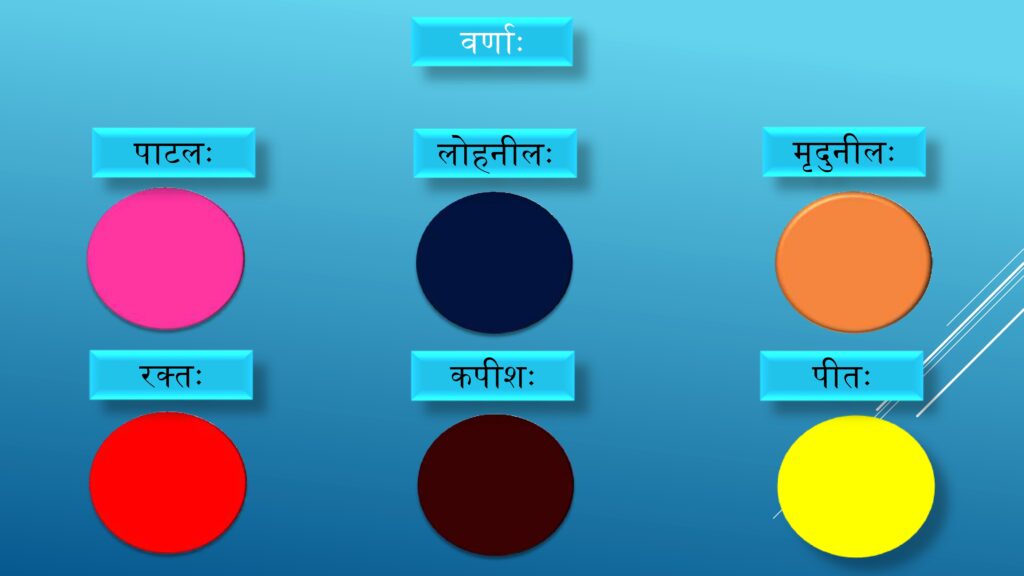
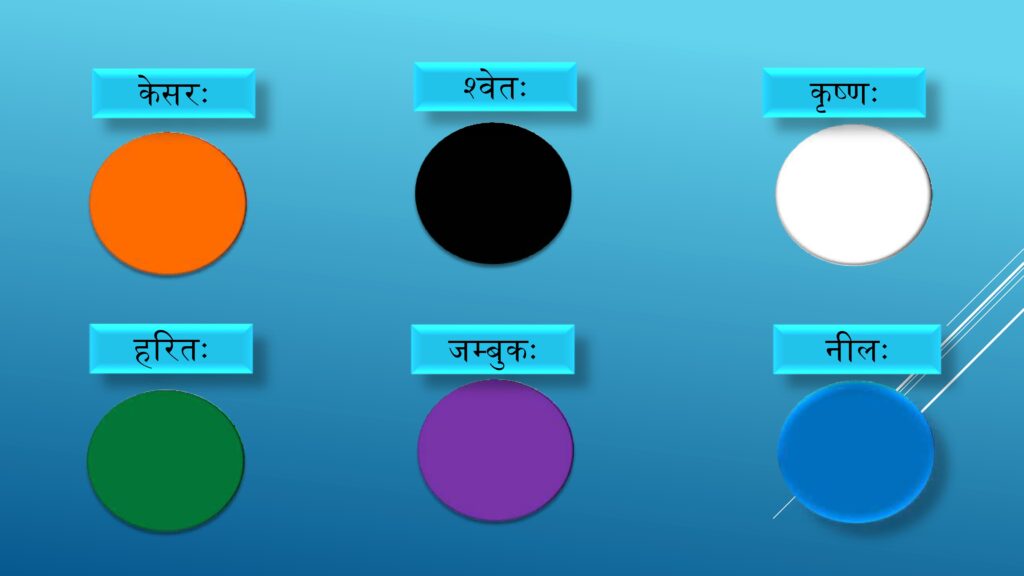
Given table provide the all list of sanskrit colours with english meaning
What Is The Spiritual Connection Of Colors
The human body has seven chakras, which are also called energy centers. These centers connect you with God or universal power. By simply thinking of a color, you can connect with divine energy and activate those energy centers.
What Is The Significance Of Colors In Hindu Culture
Color has its own importance in India and Nepal. It symbolizes both positive and negative aspects of life. Festivals like Diwali, Holi, and Dussehra are deeply connected with colors — especially Holi, which is known as the “Festival of Colors.”
- Black colour (कृष्णः) symbolizes negative energy. It’s also known as “काला जादू” in India and often associated with darkness and mystery.
- Yellow colour (पितः) symbolizes peace and silence. In Hindu culture, this color is used as a tika on the forehead and in religious rituals.
- Red colour (रक्तः) symbolizes success and victory. It gives positive vibration and energy to the aura.
Cultural Notes — Literature, Ritual & Names
In Nepal and India, colors have special meanings. Most Vedic pandits believe that white, black, green, and blue are directly connected with God and universal power. These colors are used in festivals and cultural rituals such as Holi, Diwali, and Dussehra. During Diwali, people celebrate the colors of seven lights representing joy, happiness, and success. Navratri color days are celebrated in Hindu culture across Asia during Dussehra/Dashain. Names like Neel (नील), Neela (नीला), and Shyama (श्यामा) hold special significance. Poets and songwriters also use colors such as Gulābī (गुलाबी), Lal (लाल), and Safed (सफेद) in their creations.
Colours Name in English and Sanskrit
This Table Contains the Name of Colours in Sanskrit
What Is The Symbolic Meanings of Colors In Hindus
Each box shows the color name in English, Hindi (Devanagari), and short symbolic meanings.
White (सफेद रंग)
Represents: Purity, peace, and a holy mind. Associated with: Innocence, cleanliness, and holiness.Red (लाल रंग)
Represents: Love, passion, and spiritual power. Symbolizes: Energy, bravery, and devotion.Green (हरा रंग)
Represents: Peace of mind and freshness. Associated with: Harmony, balance, and non-violence. Meaning: Peaceful life and spiritual calmness.Yellow (पीला रंग)
Represents: Knowledge, wisdom, and intellectual progress. Symbolizes: Brightness and learning. Example: The color of sunlight and yellow clothes represent knowledge.Blue (नीला रंग)
Represents: Strength, bravery, loyalty, and vastness. Symbolizes: Depth, sky, and ocean — qualities like calmness and stability. Note: Sky blue represents peace and reliability.Black (काला रंग)
Represents: Seriousness, depth, knowledge, and peace. Symbolizes: Determination, discipline, and inner strength.Conclusion
The words may seem hard in Sanskrit, so we provide pronunciation in English too. Read and memorize each word carefully — by doing so, you’ll be able to say every color name confidently in Sanskrit and understand its meaning deeply.