Number 0 to 100 In Sanskrit with Transliteration
Do yo feel harder to count number in Sanskrit ? for beginners it’s not easier for counting some big numbers. You don’t need to worry for that, we are going to simplify these probelm in easier way. Today, in this article we are going to provide a beginners ideas about knowing the English numerals in Sanskrit. Try to transliteration and memorize it correctly.
Do you have the question how to write numbers, then this article is for you. This article provide sankhya 1 to 100
Why Counting in Sanskrit Matters
Numbers carry a big role of linguistic, grammatical, culture and value for hinds.
Grammatical precision: To learn the advanced grammar you need to learn the counting. For example, एकः (ekaḥ) vs. एका (ekā) vs. एकम् (ekam).
Cultural resonance: If you want to know the culture, tradition and its value then numerals are important. You door for learning ancient text will open with numbers.
Reading real texts: Reading the ancient text and counting the verses and remembering it is really important.In mahabharata, ashtanga sequence( eight sequence), Bhagavata geeta counting the verses is essential. It also have same value for patanjali yoga sutra. You jorney for more advanced grammar, translation, and fluent reading will be faster after numerals.
.
Tens (20, 30, 40) numerals
20 – विंशति (viṁśati)
30 – त्रिंशत् (triṁśat)
40 – चत्वारिंशत् (catvāriṁśat)
50 – पञ्चाशत् (pañcāśat)
60 – षष्टिः (ṣaṣṭiḥ)
70 – सप्ततिः (saptatiḥ)
80 – अशीतिः (aśītiḥ)
90 – नवतिः (navatiḥ)
100 – शतं (śataṃ) / शतम् (śatam)
Position of Sanskrit Numbers
प्रथम (prathama) — first
द्वितीय (dvitīya) — second
तृतीय (tṛtīya) — third
चतुर्थ (caturtha) — fourth
पञ्चम (pañcama) — fifth
Why study this?
It will be easier to you to explore sanskrit text after reading numerals. You can chant the poetry , mantra and tables easily. You will get deeper insight of the ancient system. Number will give best ideas in inscription or manuscript.
Popular sanskrit numeral combination .
Ekādaśī (एकादशी) – the 11th lunar day
Ekāgra (एकाग्र) – concentrated in one thing
Triveṇī (त्रिवेणी) – when three rivers meet
Triguṇa (त्रिगुण) – three qualities (Sattva, Rajas, Tamas).
Chaturveda (चतुर्वेद) – All four vedas
Pañchāṅga (पञ्चाङ्ग) – five parts of the Hindu calendar.
Pañchakarma (पञ्चकर्म) – five purification forms in yoga
Saptarṣi (सप्तर्षि) – seven sages( Rishi)
Aṣṭāṅga (अष्टाङ्ग) – eight limbs of yoga
Aṣṭalakṣmī (अष्टलक्ष्मी) – eight forms of Goddess Lakṣmī.
Navarātri (नवरात्रि) – nine nights festival.
Saptaranga (सप्तरङ्ग): combination of seven colours
Numbers Counting 0 to 10 (0 to 10 Ginti in Sanskrit )
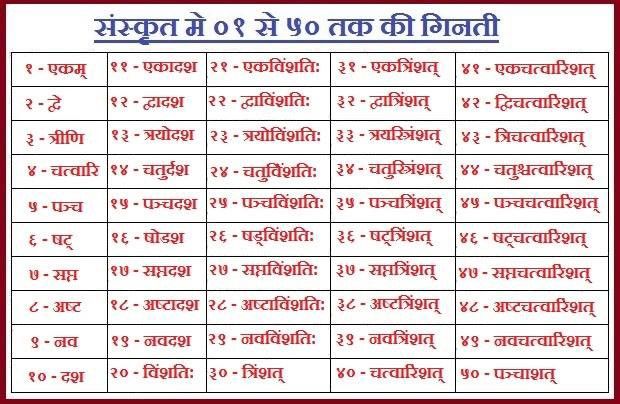
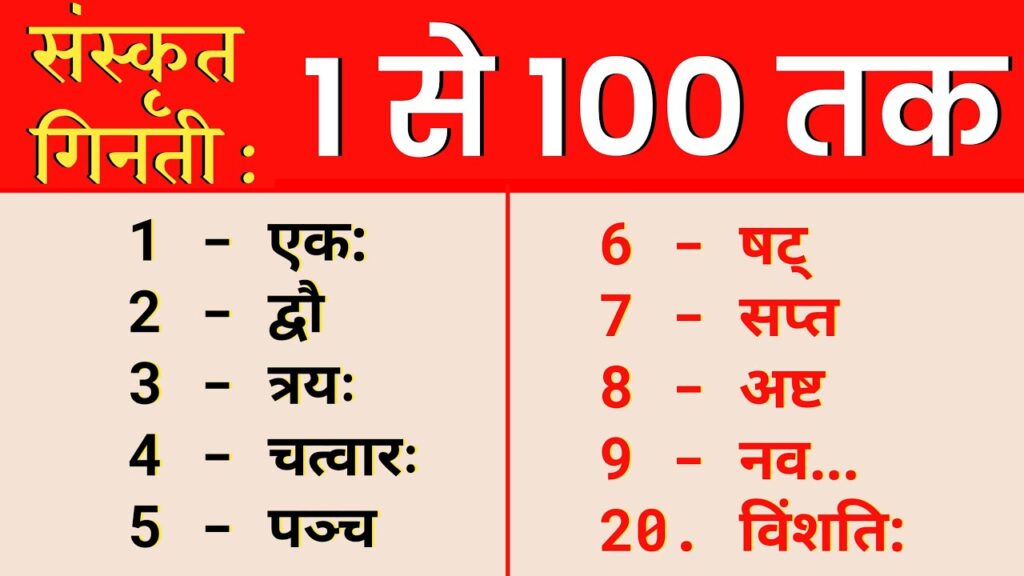
You have to remember the number from 0 to 10 first, then counting other number will be easier. because 0-10 is base. Given numbers are Shunya, Ekam, Dve, Trayaha, Chatwaaraha, Pancha, Shast, Sapta, Asta, Nawa and Dasha.
How to count number 10-20(Sanskrit Ginti 10 to 20)
You have to add दश as a suffix while counting number from ten to 20. दश define that you are counting from up to 20. Numbers are Dasha, Eka-dasha, Dwa-dasha, Traya-dasha, Chatu-dasha, Pancha-dasha, Sho-dasha, Sapta-dasha, Asta-dasha, Nawa-dasha, Binshatihi.
Counting Number 20 – 30( Sanskrit Gint From 20 to 30)
Counting in ancient language is fun to read and memorize. You have to add विंशतिः as suffix, विंशतिः(Bimsatihi) means numbers between 20 to 30. Numbers are Binshatihi, Eka-binshatihi, Dwa-binshatihi, Trayo-binshatihi, Chatu-binshatihi, Pancha-binshatihi, Shada-binshatihi, Sapta-binshatihi, Asthaa-binshatihi, Nawa-binshatihi, Trimshat.
Counting from 30 – 40(Ginti from 30 to 40)
You have to add त्रिंशत् as a suffix when counting from 30 to 40. It seems quite difficult as counting other numbers. Given numbers are Trimshat, Eka-trimshat, Dwa-trimshat, Traya-trimshat, Chatu-trimshat, Panch-trimshat, Shata-trimshat, Sapta-trimshat, Astha-trimshat, Nawa-trimshat, Chatwarimshat.
Counting From 40 – 50(40 – 50 Ginti In Sanskrit )
Given numbers are Chatwarimshat, Eka-chatwarimshat, Dawi-chatwarimshat, Tri-chatwarimshat, Chatush-chatwarimshat, Pancha-chatwarimshat, Shata-chatwarimshat, Sapta-chatwarimshat, Astha-chatwarimshat, Nawa-chatwarimshat, Panchashat.

Sanskrit Numbers from 50 to 100
From 50 to 60
From 60 to 70
From 70 to 80
From 80 to 90
From 90 to 100
शत = 100
सहस्र = 1000
अयुत = 10,000
लक्ष = 100,000
प्रयुत = 1000,000
कोटी = One million
अबुर्द = One hundred million
अब्ज = One billion
खर्ब = Ten billion
निखर्व = One hundred billion
Zero means शून्य (Shunya). According to spirituality, everything started with zero and ends in zero. Thus, counting also started with shunya.
Sanskrit Numerical Notation for Dates and Astronomy
Chronology (dates) and astronomy (Jyotiṣa) developed from ancient texts.Bhūta-saṃkhyā (भूतसंख्या) is popular among the Vedic paṇḍitas of Hindu culture. Tithi (lunar day), Nakṣatra (constellation), Saṃvatsara (year cycle), Pakṣa (fortnight), and Māsa (month) are well-known among paṇḍitas.
Scientific Legacy of These Numbers
Science started from mathematics, and mathematics evolved from Sanskritam, so this Vedic counting is essential for human development. Language, culture, science, and information technology all depend upon Sanskrit.
Origin and History of Sanskrit Numerals
Nepal is the country that taught the world to count numerals. Counting week names, the 12 months of a year, and weekday names started from Nepal. Later, Sanskritam adopted that Devanāgarī style of counting.
From eka to ekam, dui to dau, tin to traya, all emerged from the Vedic Devanāgarī script. Because of these numerals, Vedic mathematics is still popular among students.
Conclusion
In this article, we present you the numbers from 0 to 100 with pronunciation. If you need to know more number then you can simply comment down below we will provide the answer in reply. Knowing ancient number is great for all, so that try, concentrate and memorize it . This 1 to 100 ginti in sanskrit help you to know the numbers from to 0 to 100.